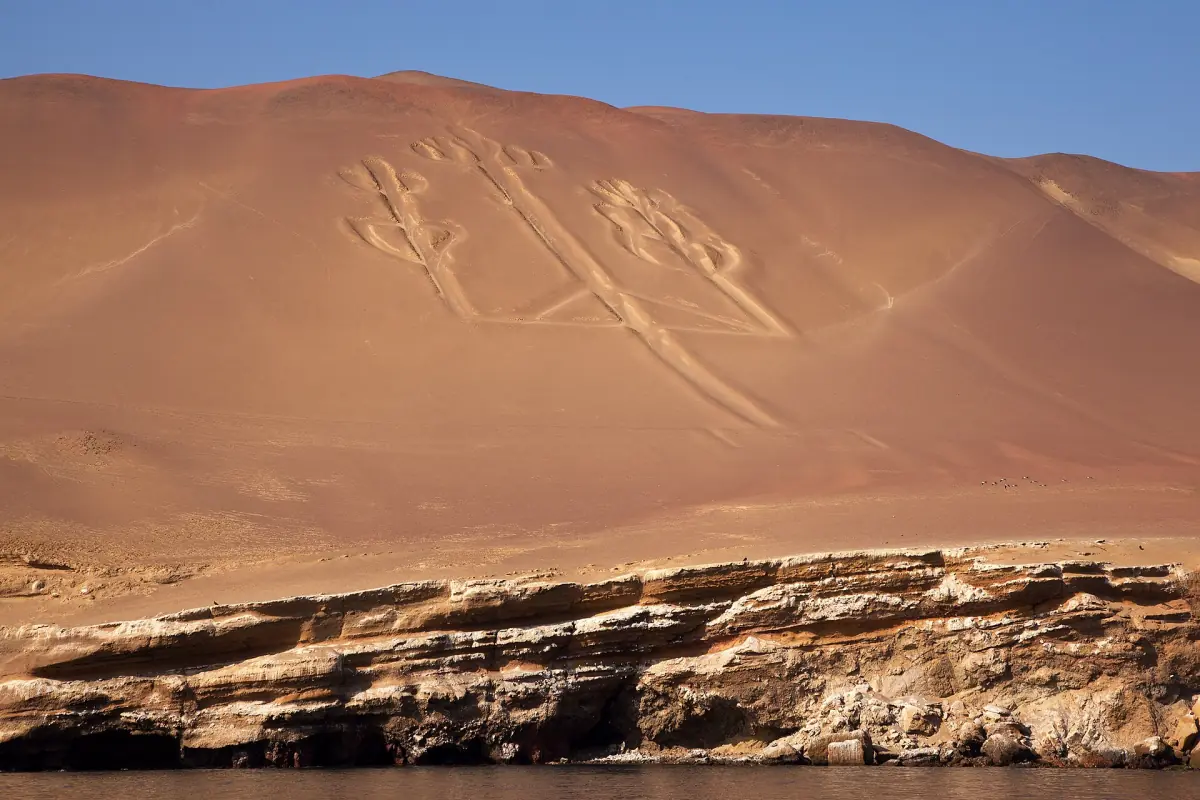
Seeing the Paracas Candelabra from a boat
The Paracas Candelabra is a geoglyph on the northern coast of the Paracas peninsula, in Pisco province in the Ica region. It can be seen from the boat route between El Chaco and the Ballestas Islands. That setting matters when planning a visit: the view is part of a journey on the water, with the dry hillside behind the figure and the coast beneath it.
Choose the sea perspective rather than planning a walk to the drawing. A boat outing and a visit to the peninsula by road are different experiences. For the wider route and wildlife context, read about Ballestas Islands boat trips. The geoglyph adds a cultural point of interest to that journey, while the islands themselves belong to a separate protected area from Paracas National Reserve.

Our pick: Ballestas by boat
This guided boat outing offers a way to visit the Ballestas area from Paracas.
Hand-picked tours, booked through Viator. Prices are indicative starting prices in US dollars (as of November 2026). Tap a tour for live availability and the current price in your currency.

Ballestas boat trip from Paracas
A fast boat, lifejacket and English or Spanish guide for a Ballestas outing from El Chaco.
History without a fixed creation date
The figure is an intriguing sight partly because its origin remains uncertain. Its age, authorship, meaning and original purpose are unresolved. Enjoy the shape and its position in the landscape without treating a proposed explanation as a settled account. A precise creation date or confident attribution to a named culture would give a certainty that the history does not support.
The same care applies to interpretations of its function. An astronomical explanation or a role as a nautical marker can sound persuasive when looking at the coast, but neither is an established purpose. Looking closely at the setting is worthwhile in itself. Separate what can be observed on the hillside from stories about why the figure was made.
A visit to the museum offers another way into the area's archaeology. Keep the histories distinct: the museum's own founding and reopening dates describe the institution, rather than dating the geoglyph. This makes a combined day more useful, because the boat view and the museum answer different interests instead of being presented as a single guided historical experience.
Museo de Sitio Julio C. Tello
The Museo de Sitio Julio C. Tello is in the reserve, on the Pisco to Puerto San Martín road at kilometre 27. It is administered by the Ministry of Culture. Treat it as its own destination, with separate admission and travel arrangements, when planning a Paracas National Reserve visit.
The museum was founded on 16 August 1964 and reopened in 2016 with new architecture and museography. Its architecture is by Sandra Barclay and Jean Pierre Crousse. There are nine permanent exhibition rooms and one temporary exhibition room. The building and the exhibition visit give a land-based complement to seeing the geoglyph from the water.
The published regular visiting schedule is Tuesday to Sunday, 09:00 to 17:00. Plan around that schedule and check the day's arrangements separately from any boat reservation. Museum entry is a separate expense; keep it in the land part of the budget rather than treating a Ballestas boat ticket as museum admission.
Putting the boat and museum into a practical day
The Ballestas outing offered here includes a fast boat, a lifejacket and an English or Spanish guide. Its meeting point is an office near El Chaco. It is a Ballestas boat experience; arrange the museum visit separately. For connections from Lima and the difference between a bus terminal and a departure pier, use the Paracas arrival guide.
Allow flexibility around the water portion because departures depend on sea conditions. Keep the boat meeting instructions accessible, wear the lifejacket and remain seated without abrupt movements. If the museum is important to the day, give it a separate place in the itinerary instead of fitting it into an assumed gap after the boat. Our weather and visit-planning guide explains why a year-round visiting season still calls for flexible plans.
Frequently asked questions
Who made the Candelabra?
Its maker, date and purpose remain unresolved. Approach cultural and functional interpretations as ideas rather than a settled history.
How should the view be planned?
Plan a sea view on the route from El Chaco towards Ballestas, with the exact meeting point and sailing arrangements taken from the boat reservation.
Is the museum included with the boat trip?
Plan the Julio C. Tello museum as a separate land visit with its own admission. The boat experience listed here includes a fast boat, lifejacket and guide.
When is the museum scheduled to open?
The published regular schedule is Tuesday to Sunday, 09:00 to 17:00. Keep museum planning separate from the boat departure time.